Monday, December 25, 2017

The Bad Plus Interviews 2017: Lowell Pickett

Ethan Iverson, Reid Anderson and Dave King
at the Dakota Jazz Club in Minneapolis
December 23, 2017
Photo (C) 2017 John Whiting
Date of interview: December 2, 2017

Owner of the Dakota Jazz Club in Minneapolis and a fixture on the Twin Cities music (and restaurant) scene for decades, Lowell Pickett has presented The Bad Plus at the Dakota numerous times; at the Cedar; in Phoenix at the Musical Instrument Museum; and in New York City. “They’re a band that gives listeners a sense of real joy,” he said. “Having them here for Christmas is one more thing that makes it worth coming home for the holidays.”

Pamela Espeland: The Dakota and The Bad Plus have a long relationship. They’ve spent every Christmas here since 2001.

Lowell Pickett: It’s been wonderful to watch them grow over the years – this upstart band that was playing these irreverent versions of pop and rock hits, which is originally what got them attention in some quarters. Nirvana’s “Smells Like Teen Spirit” and Blondie’s “Heart of Glass” and things like that.

But they also evolved and developed as individual songwriters. It was extraordinary to watch them grow into this trio where all three members contributed equally beautiful music to the repertoire they were playing, and asserted a balance between the stuff that got them initial attention – their interpretations of songs that a lot of people were familiar with – and their own incredible compositions. More and more, they became known as a band where all three members contribute equal levels of virtuosic musicality, and all three write amazing pieces.

PLE: Do you remember when you first heard them play? Did you have any idea they would be so successful?

LP: I didn’t think of it in those terms. I don’t remember ever listening to music and thinking “Wow, this is going to be successful” about anybody. You listen to music and you enjoy it. I loved the music and really enjoyed them musically.

I thought it was wonderful that as [The Bad Plus] became more successful, they continued to have a base here. Prince did that for funk and R&B and pop music, and Soul Asylum had a big hit and stayed in Minneapolis. When somebody living in a community like the Twin Cities develops a strong national and international presence, and a career that sustains them not only creatively but financially, and they stay here, that opens doors for other musicians to do the same.

[Note: Reid Anderson and Ethan Iverson live in New York; Dave King lives in the Twin Cities.]

The Bad Plus got a lot of media attention when “These Are the Vistas” came out on Columbia in 2003. They were covered in Jazz Times and Esquire. They were called “the future of jazz” and “the great white hype.”

They were on a lot of covers. They were upstarts, and some people, like Ben Ratliff of the New York Times, were immediately taken by their musicality, creativity and virtuosity. At the same time, other people felt it was a gimmick and were dismissive of them. To watch that change over the years has been great, too. The fact is, when anybody does anything new, there’s always criticism from people in the community. That’s happened with all sorts of musicians in all sorts of genres. Dylan’s an obvious example. When Dylan plugged in, people said “That’s not folk music!” Fans of Big Band swing dismissed bebop. I remember running into someone in the 1970s who was a big supporter of jazz but didn’t consider Charlie Parker jazz.

The Bad Plus certainly got a broad variety of responses. Some were incredibly supportive and laudatory and some were very critical or dismissive. They’ve proven over the years that what they were doing was real, that their musicianship was real, their compositional skills are real, and their ensemble playing was real. There weren’t many trios at the time that played as an ensemble, because most were built around one player in the group – the Ray Brown Trio or the Ahmad Jamal Trio. There was a collaborative and cooperative element to The Bad Plus band that has also proved real over the years.

What do you think their impact has been on jazz and creative music in general?

They’re certainly one of the significant groups that have opened up an interpretation of what jazz is and can be. For music to remain vital means bringing new things to it – new ideas, new approaches, new concepts. The Bad Plus helped people understand what improvised music can be, and another way it could grow. And they’ve legitimized what they’re doing in the eyes of the world. They’ve proven over the years that their creativity and their virtuosity were the real deal. They’re just such incredible musicians, and they write so beautifully. All three of them.

Who do you think their heirs are, if any? GoGo Penguin for sure, although they’re probably more E.S.T. than TBP.

All sorts of musicians have benefitted, and in different ways. I think it’s too early to talk about who their heirs are. They’re still creating.

What thoughts do you have on Ethan leaving and Orrin coming in?

Orrin is a sensational pianist. He’s been to the Dakota several times. I know he’s played with Sean Jones and Christian McBride. I’d have to go back and figure out all the bands.

I’ve heard people say that with Ethan gone, The Bad Plus won’t be the same.

No, it won’t be the same, and that’s a good thing. What The Bad Plus are doing now isn’t the same as what they were doing 15 years ago. Back then, they were known almost exclusively for their interpretations of pop and rock songs, and now they’re known as a band that writes significant amounts of their own music.

The Bad Plus Interviews 2017: Philip Bither


The Bad Plus Bill Frisell at the Walker
September 29, 2017
Photo (C) 2017 John Whiting
Date of interview: December 1, 2017

Philip Bither is the performing arts curator for the Walker Art Center in Minneapolis. He first became aware of The Bad Plus in 2003, when “These Are the Vistas” came out on Columbia. The band made four major appearances at the Walker: in 2003 at Rock the Garden, the Twin Cities’ popular annual outdoor concert, where The Bad Plus shared top billing with Wilco; in 2005 for “The Festival Dancing in Your Head,” a three-day celebration of Ornette Coleman’s genius; in 2010 for “King for Two Days,” a special event spotlighting Bad Plus drummer Dave King and featuring several of the bands he’s involved with; and, most recently, in September 2017 for “The Bad Plus Bill Frisell ’85–’95,” a Walker co-commission with Frisell as guest artist.

King and Bad Plus bassist Reid Anderson first heard Frisell at the Walker in the 1980s and ’90s, when they were high-school students. They jumped at the chance to play live with their hero on the Walker’s stage. In October, they performed with Frisell in Columbus, Ohio; Urbana, Illinois; and for six sold-out nights at the Village Vanguard.

Pamela Espeland: The commission with The Bad Plus and Bill Frisell was in the works before the band announced that Ethan would be leaving. Did the news have any effect on what happened at the Walker?

Philip Bither: Dave told me fairly early on in the development what was going on with the band shifting, and Ethan [Iverson’s] decision to move on in new directions. But he said – and all three confirmed this when they got here to start the rehearsal process – how exciting it was for them to do this kind of project. They had done a few things together around Paul Motian’s music, but no major, dig-deep project like this for the Walker, with and for Frisell. Ethan seemed fully connected and interested in the project as much as Reid and Dave. [After the Vanguard shows], Dave sent me a picture of Robert Plant backstage with the three of them, telling them how much he loved the set.

I think [The Bad Plus] is something that Minnesota and the Twin Cities should be really proud of. Even though Reid and Ethan live in New York, it’s considered a Minnesota band. The fact that this community helped give birth to the trio, and then to see the national and international success they’ve achieved, is a great reflection on the music scene here in the Twin Cities and the cultural scene at large. I’m glad that the Walker, way before my time, was able to provide opportunities to see great musicians that [Reid, Ethan and Dave] would come and check out.

PLE: Did you notice any tension between the band members in September, when they were here with Bill Frisell?

PB: No. Everybody was really cordial with us. They all seemed to love the connection with Bill. I kind of had my radar up, but my sense was that they really appreciated the opportunity to do the project, to pursue a commission with the Walker.

This was actually our first formal commission with The Bad Plus, but it had a wonderful symmetry around their connections with the Walker’s music program, which served in their teenage years as a kind of tutorial around who was doing what on the contemporary edge of jazz. They fell in love with a number of artists, Frisell in particular, and the chance to return to honor somebody who was important to them in their earlier years was exciting for them. It was exciting for us, too, to look back at our own history.

Just a couple years after [The Bad Plus] formed, we invited them to play Rock the Garden [2003], one of the great Rock the Gardens. Then they came back to play a key role in our Ornette Coleman festival, “Dancing in Your Head” [2005]. Both The Bad Plus and [King’s band] Happy Apple played, and the combination, Bad Apple. I’ll never forget Ornette, who was in the house for the tribute concert, making a particular point backstage of telling The Bad Plus how much he appreciated their approach to his music. Of course, Ornette’s always been in the DNA of The Bad Plus, part of how they think about their music and how they play. [In 2016], The Bad Plus played Ornette’s “Science Fiction” at the Chicago Jazz Fest. There were nice links there.

The trio was the cornerstone to a celebration of Dave King’s own work [at “King for Two Days” in 2010], so it made great sense to have them back seven years later. We didn’t know when we first started talking with them [about the Frisell project] that Ethan would be stepping away, but of course, given our long history with the band, it felt great to have Ethan still in the lineup when they revisited Frisell’s work.

For The Bad Plus, the Walker has not been an annual thing or a place they play all the time but a place I think they look to as a home for unique, special moments in the trio’s career.

When did you first become aware of The Bad Plus?

I met Dave soon after moving here in 1997. I think I saw him play with some other musicians. I didn’t really know about The Bad Plus until “These Are the Vistas” came out [in 2003]. Right away, I knew this was a band Dave King was in, and I soon heard about Reid and Dave growing up here, and Ethan not that far away in Wisconsin. So I started following them.

[After “These Are the Vistas”] there was this big critical split, with some of the jazz critical community dismissing them as a novelty that just covered rock tunes. I felt like those first records were great and what jazz needed in a certain way. Not to say that jazz was just waiting for someone to cover Nirvana’s “Feels Like Teen Spirit,” but their ears were wide open and they weren’t making genre distinctions about what was and was not good music.

I think it’s healthy for jazz to have different generational and stylistic inclusions. Nobody yelled at bebop musicians in the ’40s and ’50s for doing Rodgers and Hart. I was on the side of cheering them on. Sometimes the jazz purist world gets deeply suspicious when someone is successful and is attracting big houses, like somehow this can’t be pure enough. It’s been nice to watch the broader music community, and the jazz community overall, go from being suspicious [of The Bad Plus] to taking them seriously, to the point where they’re considered one of the great American bands. They’ve proven a lot of skeptics wrong with the seriousness of their original compositions.

What do you think has been their impact on jazz and creative music?

They helped break down barriers around what jazz can wrap its arms around compositionally. There’s a playfulness and an irreverence, almost a kind of punk attitude, about shaking things up and being humorous at times. They’re committed to the importance of every gig mattering and putting on fantastic live performances. They infused new energy into the standard piano trio that has been a staple form for jazz for decades.

Not to be too regionally boosterish, but I think it’s sort of a Midwestern sensibility to be generous and collaborative and supportive of one another. Their regular-dudes, regular-people energy is somewhat tied to a Midwestern orientation. But they’re fierce musicians, and they’ve proved their critics wrong. Some people feel they’ve injected a rock energy into jazz. I think that’s simplistic. Each individual member brings his own qualities into the band in a way that gels so beautifully. Each works from distinctly different aesthetics. But the fact that they have collectively led this trio, and have all contributed as composers to the body of work, is pretty rare and pretty great.

To me, their connection to a cool and eclectic spectrum of pop and rock tunes was a positive, because they approached them creatively. They would deconstruct them, and sometimes people wouldn’t even know exactly what tune it was. People would think, “I know that melody …” and then, two-thirds of the way through, someone would say “That’s a Madonna tune!”

I love to see how connected they’ve become to so many different musicians and parts of the jazz lineage; [an example is] their recent record with Josh Redman [“The Bad Plus Joshua Redman,” 2015]. They’re so connected now that they’re an important pillar within the current jazz scene. I think that they have contributed a lot to helping shape the jazz of our time. They raised the level of the conversation. It was partly the controversy, and that’s kind of what they became known for, but that’s a reductive way of thinking about them, because they were so much more than that.

Related:

Wednesday, November 29, 2017

The triumphant, transcendent return of Fat Kid Wednesdays

Adam Linz, JT Bates, Michael Lewis

“Fat Kid Wednesdays.” What kind of band name is that?

The kind you make up when you’re teenagers crazy for jazz.

Michael Lewis (saxophones), Adam Linz (bass) and JT Bates (drums) started playing together as friends in high school. On Monday, November 27, 2017, some 26 years later, they played two sets at Icehouse.

Between then and now, they played together often, then less and less. For years, they were the band in residence at the Clown Lounge, a bar in the basement of the old Turf Club. The Clown closed suddenly in January 2011. Two years earlier, in January 2009, Fat Kids spent two nights at the Stone, John Zorn’s club in New York City. Someone reviewed the first night for the New Yorker’s Culture Desk, noting the trio’s “preternatural mutual responsiveness that comes from an instinctive sympathy, but is developed over time through work” and their “exhilarating performance” that “revealed both the depth of their individual artistry and the symbiotic wonder of their interplay.” The review ended with “They play again tonight. Don’t miss it.”

Fat Kids made some albums: “Shiftercar,” “Singles,” “The Art of Cherry.” A mini-album called “Bomb” is listed at Discogs.com, and something called “Set One” is available at Shifting Paradigm Records. Some songs “recorded at the clown lounge by sam” are on myspace but no longer playable. Same goes for a few labeled “Minnesota sur Festival,” which means recorded at the Minnesota Sur Seine Festival, a late, much-lamented, trés amazing improvised music festival held in the mid-2000s that brought artists from France to play with artists in Minnesota. Fat Kids played often in France.

When Mike, Adam and JT took the stage at Icehouse on Monday, it had been four years since they last played together. The room was packed. The tables had been moved around to make standing room for 120 people. Everyone was there to listen.

I don’t know what they played. They didn’t announce the songs. The singer Wendy Lewis, who is Mike’s aunt, thought she heard a reconstructed “Stardust.” I thought I heard Mingus. And so many other things; hints and asides that teased and evaporated. The music washed over the room in bursts of playfulness and waves of beauty. There were ballads so full of emotion that I wanted to weep. I had forgotten the trio could do this, or maybe they’re better at doing it now, as men in their forties, grown, working, with histories, making lives for themselves, all as in-demand, professional musicians. 

Mike’s saxophones wailed, screamed and sighed as he paced the stage. Adam’s big, gorgeous-sounding acoustic bass sang with a human voice. JT’s drums – clutches of thunder, crashes, skitters, the shimmer of cymbals – seemed like the source of all rhythm. They were happy to be together, old friends hanging out and doing what they love. We were damn lucky to be there.

During one song, near the end, I barely breathed. Without words, Mike’s saxophone told a story of sadness, longing, regret, wisdom and acceptance. I am not exaggerating. His horn said all of that and probably more. I heard it very clearly. I wish there had been a photographer on the stage, taking pictures of the crowd and the wonder on our faces, because the whole room was transfixed by the music. Afterward, I turned to Mary Lewis, Mike’s mom, and asked, “Where did that come from?” She put her hand on her heart.


Adam Linz, JT Bates, Michael Lewis

Thursday, December 22, 2016

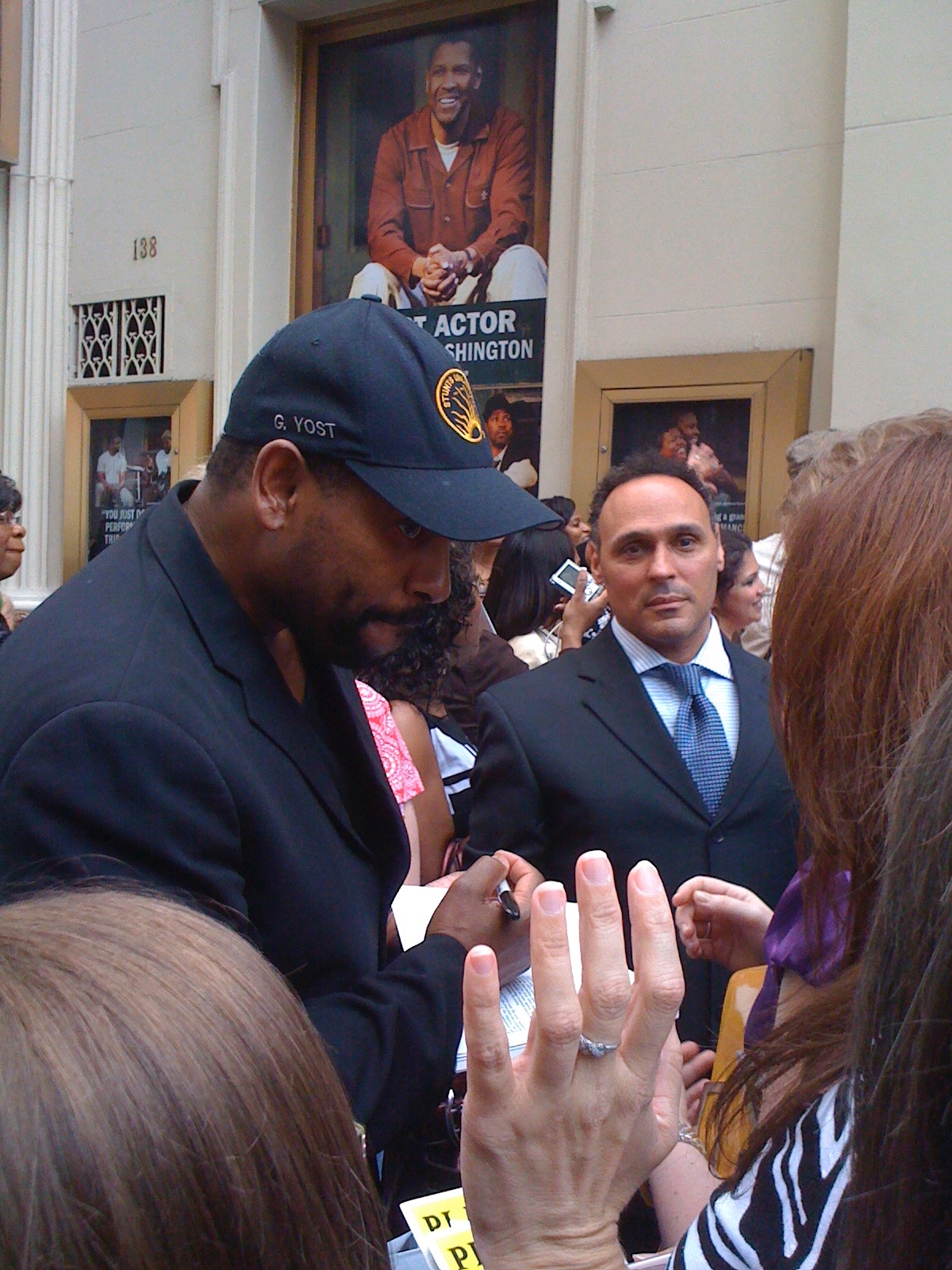
On seeing Denzel Washington in “Fences” at the Cort Theatre on May 16, 2010

In line for "Fences," May 16, 2010
Denzel Washington’s “Fences,” his big-screen adaptation of August Wilson’s play, opens Christmas Day and is already being hailed as a strong Oscar contender.

Washington has also made a deal with HBO to executive produce adaptations of the other nine plays in Wilson’s “Century Cycle,” also known as his “Pittsburgh Cycle” (because all 10 plays are set in Pittsburgh).

This is tremendous good news for him, the plays, African American actors (here come a lot of movie roles for African American actors) and for American culture as a whole, because Wilson’s cycle about African American life in the 20th century is a pearl of great price.

“Fences” premiered on Broadway at the 46th Street Theatre on March 26, 1987, ran for 525 performances and won four Tonys. The first Broadway revival opened on April 26, 2010, for a limited 13-week run and won three Tonys: for Best Revival of a Play, Best Actress in a Play (Viola Davis), and Best Actor in a Play (Washington), his first and so far only Tony.

The cast of the movie is almost identical to the cast of the Broadway revival, with Washington, Davis, Stephen McKinley Henderson, Russell Hornsby and Mykelti Williamson all reprising their roles as Troy Maxson, Rose Maxson, Jim Bono, Lyons and Gabriel. On Broadway, Eden Duncan-Smith and SaCha Stewart-Coleman alternated in the role of Raynell, and Chris Chalk played Cory. In the film, Saniyya Sidney is Raynell and Jovan Adepo is Cory.

We saw the 3 p.m. matinee on May 16. Our seats were high in the Cort’s balcony, which has such a steep rake that everyone has an unobstructed view.

The set of "Fences," from the balcony
Seated around us were several ladies who had come into New York by bus from Atlantic City. They had enjoyed long lunches with cocktails and wine, which they were chatting about. They were excited and happy.

When the house lights dimmed and Henderson and Washington walked on stage – they have the first lines – the ladies screamed. Even from the balcony, Washington was a powerful presence, sending out hot Denzel waves. He may be one of the few actors who doesn’t appear smaller in person than he does on screen. He definitely has charisma. I almost screamed myself. I’m not lying; it was thrilling.

He ignored the noise and said his lines, and continued to say his lines. Throughout the play, some members of the crowd gave feedback. They cheered and gasped, yelled “You go, girl!” when Rose (Davis) stood up to Troy (Washington) and “No, you didn’t!” when someone said something outrageous. Halfway through the first act, a woman seated in our row, a few seats away, started snoring.

During intermission, the snoring was a topic of conversation. “Did you hear that?” “Somebody was snoring.” “Who was snoring?” Several people turned to look at us. I looked back. “Oh, no,” I said. “Honest, it wasn’t me. Or him, either.” By now, the snorer was awake, sitting up and acting all innocent. We didn't blow her cover.

We had seen “Fences” before, in a 2008 Penumbra Theatre production directed by Lou Bellamy, with this stellar cast: James. A. Williams, Marion McClinton, Elayn J. Taylor, Kevin D. West, James Craven and James T. Alred, with Marianne McGee and Mahogany Ellis alternating as Raynell. So we knew the play. Parts of the Penumbra show were still in my head, and I thought – this New York play is awfully good, but so was ours back in St. Paul. Washington’s sparkling star-power aura was something, but it wasn’t everything. I’d still rather see an August Wilson play at Penumbra.

On the way out, we ran into Matthew Fox, another heartthrob and the star of “Lost,” which was in its last season (the final episode would air a week later, on May 23). John shook his hand and said “Thanks for doing what you do.” Fox said, “Thanks, man.”

We joined the crowd at the stage door. Washington never came out (or left earlier), but Williamson, Davis and Chalk did. I had brought my copy of “Fences” from the Century Cycle box set published by Theatre Communications Group (an investment I made years back, so glad), and Davis and Williamson signed it.

The stage door after the play
Mykelti Williamson and Chris Chalk 
Mykelti Williamson
Security, Mykelti Williamson and Chris Chalk
Top center: a peek at Viola Davis

Johnny, New York City, May 16, 2010

Friday, October 14, 2016

Visiting Minnesota, poet Billy Collins calls Bob Dylan’s Nobel Prize a “bold choice”

Billy Collins by Suzannah Gilman
When Bob Dylan won the Nobel Prize for Literature, former U.S. poet laureate Billy Collins was in Minnesota, making two appearances for Pen Pals, the Friends of the Hennepin County Library’s author series. It seemed only natural that someone would ask Collins his opinion on that, and on Friday morning, Oct. 14, at the Hopkins Center for the Arts, someone did.

“I was fine with it,” Collins told the sold-out crowd who had come to hear him read and speak. “The Nobel Prize committee often comes up with obscure writers, and you have to play catch-up [to learn who they are]. But you don’t have to google Bob Dylan.

“Some people are saying [Dylan’s lyrics] are not quite literature. Students are asking, ‘What about Jim Morrison? He’s a poet, isn’t he?’

(Pause.) “No.” (Pause.) (Crowd laughter.)

“If you want to test to see if a song lyric is a poem,” Collins continued, “you have to get everyone off stage, including the three singers in their sparkly dresses, so all you have is a piece of paper with the lyric, and then you read the lyric. ‘Come on, baby, light my fire/Come on, baby, light my fire’ is not a poem.

“I’ve read [Dylan’s] lyrics on paper, and his liner notes. And I think his lyrics do hold up on paper.

“I thought it was an inspired, bold choice, and I’m all for it.”

Collins is a rock star himself, in the literary world, poetry subcategory. He has a new book, “The Rain in Portugal,” which made its debut today at #15 on the New York Times bestseller list for hardcover fiction (because the Times doesn’t have a bestseller list for poetry), which put Collins in a good mood. Or maybe he was already in a good mood. He seemed like a happy man, someone you’d like to know, genial, glad to be a poet, and a successful one at that. In a little over an hour, leaving time at the end for a Q-and-A, he read 26 poems, interspersing them with often humorous anecdotes.

Collins’ poems are plainspoken, laced with humor, yet profound. They usually start with something simple, even mundane, then rise up and expand in meaning and importance, sometimes to the point of majesty.

Two poems he read on Friday morning, “1960” and “Nightclub,” made jazz references. According to his Facebook page (which is updated by his management and publisher, not Collins himself, but with his approval), he recently read a poem aloud to Wynton Marsalis. The poem, “Man Listening to Disc,” mentions Sonny Rollins, bassist Tommy Potter, drummer Arthur Taylor and Thelonious Monk, and the track “The Way You Look Tonight,” so Collins was probably writing about the Concord recording “Thelonious Monk/Sonny Rollins.”

Because Collins is a rock-star poet, here’s his set list from Friday – the titles of the poems he read. Many are from “The Rain in Portugal,” but not all. Some, like “The Lanyard” and “Forgetfulness,” are old favorites people in the audience already knew.

“You, Reader”
“1960”
“Lucky Cat”
“Only Child”
“Predator”
“In Praise of Ignorance”
“Sixteen Years Old, I Help Bring in the Hay on My Uncle John’s Farms with Two French-Canadian Workers”
“December 1”
“Down on the Farm”
(a poem about staying awake at night wondering which member of a couple would die first; sorry, didn’t catch this title)
“Cheerios”
“To My Favorite Seventeen-Year-Old High School Girl”
“Royal Aristocrat”
“The Death of the Hat”
“The Lanyard”
“The Golden Years”
“Oh My God!”
“Divorce”
“Flock”
“No Time”
“Elk River Falls”
“Dharma”
“Forgetfulness”
“Nostalgia”
“On Turning Ten”
“Nightclub”

He introduced each poem, or followed it up, with a brief comment, story or explanation. A selection: 

 -- “Our cat shows no sign of going anywhere except from room to room. … She looks like she has something to say, but she just forgot it. She’ll stare at you, and you’re sure she’s about to speak, then she’ll blink and you’ll know she just lost it.”
 -- “Poetry began as a series of memory tools, mnemonic devices – the impulse to write, to capture a moment in amber.”
 -- “A friend used to stay awake at night wondering which Everly Brother would die first. He liked them both equally.”
 -- “Poems can arise from the meanest of circumstances.” (An example: his poem “Cheerios,” which he wrote after learning that he and the cereal are the same age.)
 -- “Here’s how poetry works: You start with something simple and see how it goes. An object gathers significance.” (From his introduction to “Lanyard,” which was sparked by seeing the word “Lanyard” in the dictionary. He noted that “no cookie nibbled by a French poet could send one so quickly into the past” as that word did for him, which yanked him back in time to summer camp, when he wove a lanyard for his mother. “I could have made her a potholder, but I probably wouldn’t have written a poem about it.”)
 -- “Here’s a sonnet, just because I can do it.”
 -- “A nutshell is another name for the grave. … If you think writing a funny poem about your dead parents is easy, give it a whirl.”
 -- “Majoring in English is pretty much majoring in death. Most poems are about mortality. That’s what gets poets up in the morning.”

Collins’ responses to audience questions during the Q-and-A gave insight into his process, how he writes poetry and what others who want to write poetry might try. A selection:

-- On the state of mind that produces poems: “Vigilance. … I’ve never sat down to write. I’ve never had any work habits. … Poetry is an exploitative, opportunistic view of human experience. … Being able to spot something you think might have poetic possibilities, then trying it out later.” He always has a notebook, and many of his poems begin with something he’s written there.
 -- On poetry and emotion: “Young people write at night. That’s not a good idea. It intensifies your feeling of being the only person in the world. … The worst thing is to be emotional in a poem. You have to play it cool, to write cold. You want your reader to be emotional. … You’re trying to get a stranger to be interested in you and your life. Readers don’t come to poetry because they care about you; they come because they care about poetry. You have to convince them that you love poetry as much as they do. That links you together.”
 -- On science fiction: “All science fiction is about two things: either we go there, or they come here.”
 -- On learning from an audience member that all the letters for the word “typewriter” are found on the top row of the keyboard: “I didn’t know that. Thank you, Mrs. Qwerty.”

When asked, “How does it feel to stand in front of hundreds of women who are profoundly in love with you?” Collins said, “It feels good. And that’s a good note to end on.”

On the way out, everyone received a copy of “The Rain in Portugal.”

Tuesday, August 23, 2016

Ethan Iverson talks about his Steinway, Sweeney, Paulson, and Trump post

On Friday, August 19, pianist Ethan Iverson added a new post to his blog, Do the M@th, and announced it on Twitter:


Iverson had learned that hedge fund billionaire John Paulson, whose company bought Steinway Musical Instruments in 2013, was recently named to Donald Trump’s economic team.

“As far as I know,” Iverson wrote, “this post is the first to make the Trump/Steinway connection explicit to an arts audience.”

The Sweeney is Michael Sweeney, former Steinway CEO, with whom Iverson had a cordial relationship. Sweeney left the company last week. According to CNBC, “A Steinway spokesman would not say if Sweeney, 58, resigned or was forced out of the company, or reveal what led to him leaving.” Ron Losby, Steinway president since 2008, has taken over as CEO.

Excerpts from Iverson’s post (not that you shouldn’t read it yourself):

·      About Paulson: “Getting into bed with Donald Trump crosses a line.”
·      “With the Paulson/Trump alliance in full effect, I can’t in good conscience keep asking promoters to go out of their way to provide me with Steinway pianos.”
·      Iverson mentions being “on the verge of becoming a full-scale Steinway artist” and enjoying “some nice privileges.”
·      “I do think my fellow pianists should at least be aware of this jarring dissonance at the top end of Steinway’s (pay) scale.”
·      “After all, while we all love beautiful things, part of our greater worth is the company we keep.”

Iverson played a solo concert in Minneapolis on Saturday, August 20. He answered a few questions afterward about his post and Steinway decision.

PLE: You mention being “on the verge of becoming a Steinway artist.”

Ethan Iverson: [I was told] I could have all the privileges of being a Steinway artist, but I wouldn’t become a full Steinway artist until I actually owned a Steinway. I bought a low-end Boston, which is a great little piano, and was going to work up to buying a Steinway. But I was already thinking about making requests for [Steinway] pianos for certain venues. They gave us a great deal on the piano we used to make our new album.

[Iverson is talking about It’s Hard, the new album by The Bad Plus, his trio with Reid Anderson and Dave King, that comes out Aug. 26.]

Did you talk with Reid and Dave about your post?

I talked to a couple of people in the industry and fellow pianists. I didn’t really talk to Reid and Dave because for years The Bad Plus has played whatever pianos are there at the venue. I think there’s plenty of room to worry about other things about your musicianship before you become a piano diva, especially if you’re a jazz player. If you’re playing virtuosic classical music for a living, that’s a different kettle of fish.

Have you gotten any pushback on your post?

Everybody seems to think I’m the hero of the hour. Both Marc-André Hamelin – in my opinion, the greatest living classical pianist – and Thomas Adès – whom I think is the greatest composer – tweeted positive things. Alex Ross put it on his blog [The Rest Is Noise] today. [Ross called it “an important, dismaying read.”] A lot of people retweeted it.

Did something happen that brought this on?

I was at dinner with a person who’s in the financial world, and he told me Paulson was the Steinway owner and was Trump’s economic advisor. I hadn’t connected those dots.

I think probably everyone in music just looked at the list of Donald Trump economic advisors and didn’t really pay any attention. I didn’t really pay any attention either, but I did see Paulson speak at the Steinway gala [on March 14] and had a negative impression. Then I was like, “Wait a minute, who is this guy?” And I started doing my research, and it became obvious to me that this was something we should know about.

It’s worth knowing so people think, “Maybe I don’t need to go with Steinway. Maybe I can go with someone else.” There’s the first African-American piano maker, a guy named Warren Shadd, and I’ve been thinking I should go down and play a Shadd piano. There are some extraordinary Yamahas now. They’ve really upped their high-end game.

60 or 70 years ago, there were about 50 piano makers, and now it’s essentially down to a couple, and everyone wants to play a Steinway because it’s the only handmade one. It would be nice to have a little more competition for Steinway.

This is a serious decision for you as a pianist.

I lost a night of sleep over it. I thought, “Am I really going to do this?” But I figured, “Who knows what the future brings?” It’s not like I’m never going to play any Steinways anymore. There are Steinways at a lot of venues. What I’m really giving up is being in that elite class of Steinway pianists.

And that’s really not my personality anyway. I bang around Bohemian style. That’s sort of what I believe in. And frankly, I think that East Coast elite stuff is really a drag. And for someone like John Paulson, I think almost any musician is probably not much … I can’t speak for Paulson, but I’ve met various rich people on the East Coast, and sometimes they have an appreciation of art only as something that ornaments their wealth. I think that perspective is horrible.

Being economic advisor to Donald Trump, as I wrote, just crosses the line.

What do you see as the consequences for you personally? Beyond not being a Steinway artist?

I like some of the people at Steinway, and I know it was probably not good for them that I posted this. So that was a little problematic. I don’t want to make life worse for anybody. On the other hand, I’m just a little jazz blogger. It’s hard to know what the consequences are of anything. But it was totally dark and I turned on the light. And there might be consequences there, I suppose. Who knows? Is this any of my business? Maybe I should just let it lie.

Truthfully, I don’t think it’s going to make any difference to anything. But if just a few people I know and respect who didn’t know about it now know about it, and it’s part of the conversation, that’s as much as I could hope for.

***

On August 23, Norman Lebrecht featured Iverson’s post on his Slipped Disc blog, with (nice touch, Norman) a photograph of a Steinway lying on its back.